
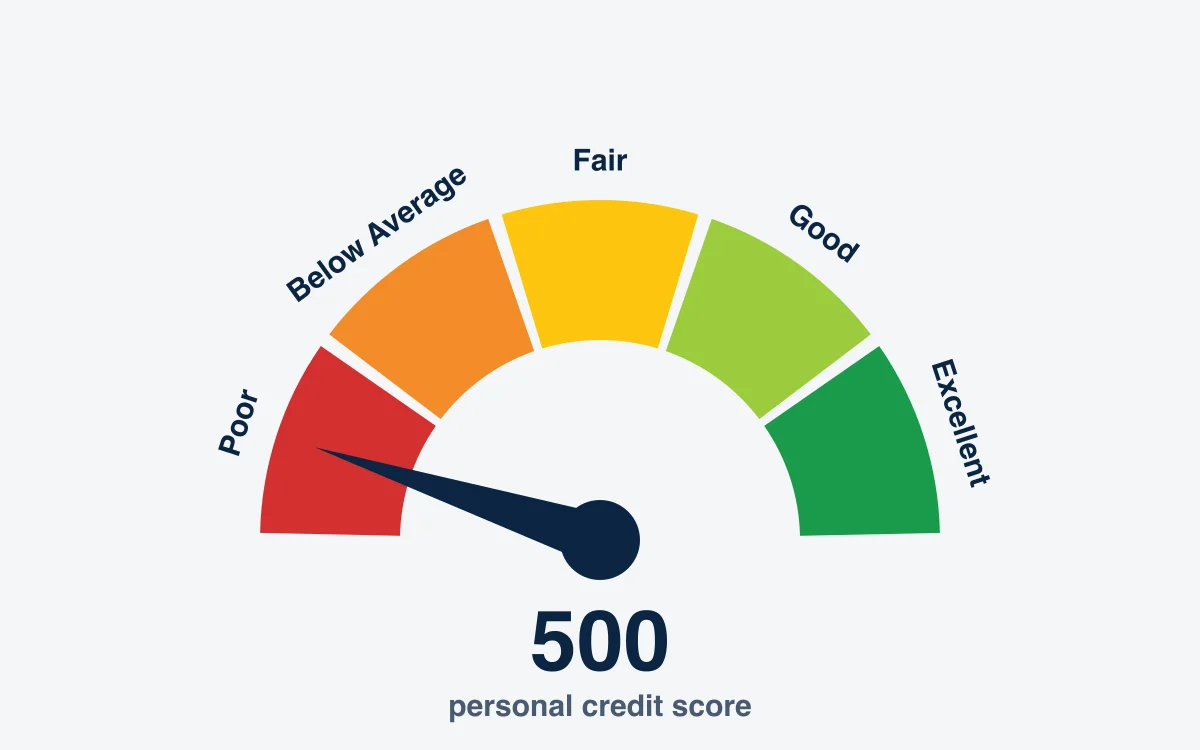
- A merchant cash advance starts at a 500 FICO, and 500 is the most common minimum across funders. Some funders ask for 550 or 600, and an approval at exactly 500 happens but is not the norm.
- The score never decides a file by itself. It decides which funders will look at it. Strong, steady bank statements are what make a file workable.
- At a lower score, expect a smaller amount, a factor rate toward the higher end of the range and a shorter term.
- A line of credit, term loan, equipment financing and SBA loan all ask for higher scores. Invoice factoring looks mainly at your customers.
A merchant cash advance is the purchase of a portion of your future sales. It is not a loan.
Is it possible at a 500 score?
Yes. A merchant cash advance is realistic at a personal credit score around 500, and 500 is the most common minimum score across funders, ahead of 550 and 600. A few funders state a floor below 500, and many sit higher.
One caveat: some funders that advertise 500 ask for 550 in their actual requirements. So an approval at exactly 500 happens, but it is not the norm. The score alone never approves a file. It only decides which funders will look at it.
See what your business may qualify for
About 30 seconds to start.
What funders weigh more than the score
For an advance, the bank statements carry the most weight:
- Monthly deposit totals, and how steady they are
- The average daily balance the account keeps
- Negative days and overdrafts
- Time in business
- How much of your revenue is already committed to existing advances
How a 500 score changes the offer
A lower score shrinks and prices the deal. It does not usually end it. Expect a smaller first amount than the same business would get with a higher score, a factor rate toward the higher end of the range, and a shorter term. A shorter term makes the daily remittance heavier relative to the amount you receive.
Funders protect themselves with amount and price when the score gives them less comfort. As an advance is remitted cleanly, renewals are where the amounts grow.
Which products fit at a score near 500
Most funding products ask for more than 500. This is what each one asks for:
- Merchant cash advance: realistic. The minimum starts at a 500 FICO.
- Invoice factoring: realistic. The factor looks mainly at whether your customer will pay the invoice, so your own score matters less.
- Business line of credit: not realistic. The minimum starts at 650.
- Business term loan: not realistic. The minimum starts at 600.
- Equipment financing: not realistic at 500. The minimum starts at 600.
- SBA loans: not realistic. SBA lenders typically look for a personal score of 680 or higher, and some go lower.
Credit pulls
Whether a funder pulls your credit, and what kind of pull, varies by funder and product. Some funders run a hard inquiry before funding. Term loans, lines of credit and SBA loans involve hard pulls.
How much any pull moves a score depends on your whole credit report, so no one can promise a number. Ask each funder what it pulls and when.
What helps a file with a lower score
These are the things that improve the file a funder sees:
- Three recent months of strong, steady deposits in the business account
- A clean recent statement history, with few or no negative days and no returned debits
- A higher average daily balance, even a modest one
- More time in business
- Paying down or paying off an open advance before you apply, which frees up payment room
- Complete statements, every page, since an incomplete file is judged on its worst assumption
Why files at this level get declined
These are the most common reasons:
- The statements cannot carry a daily remittance: a low average balance or frequent negative days
- Revenue below the funder's floor, or falling month to month
- Too much existing advance load already coming out of the account
- Returned or missed debits on an existing advance
- Recent bankruptcies, tax liens or open judgments, which many funders restrict outright
What to avoid
Avoid anyone who promises guaranteed approval at any score. Avoid credit repair companies that promise a specific score by a specific date. Nothing they do changes what your statements show this month, and the statements are what is being underwritten.
Avoid applying for bank products at many places at once. That stacks hard inquiries for products a 500 score is unlikely to get. And never hide an open advance or alter a statement. The existing debits are printed on the statements, and a file caught doing this is finished everywhere, not just with one funder.
Compare the deal before you accept
At a lower score, the same business pays more for less money. A smaller amount at a higher factor rate over a shorter term costs more per dollar received and takes a bigger daily bite than the deal a higher score gets. That can still be the right trade when the money puts revenue in the account. Compare the total you will remit and the daily remittance against your deposits, not just the approval.
The trap at this level is taking a second expensive advance to carry the first. That is where files break.
The same $50,000 at each end of the factor range
| Advance | $50,000 |
|---|---|
| At a 1.25 factor rate | $62,500 to remit, about $496 per business day over roughly 6 months (126 business days) |
| At a 1.50 factor rate | $75,000 to remit, about $595 per business day over the same 126 business days |
| The difference | $12,500 more to remit, and about $99 more each business day |
Example only. Most advances price between 1.25 and 1.50. Your amount, rate and schedule depend on your business and the offer you receive.
Subject to approval. Amounts, timing and terms vary and are not guaranteed.