
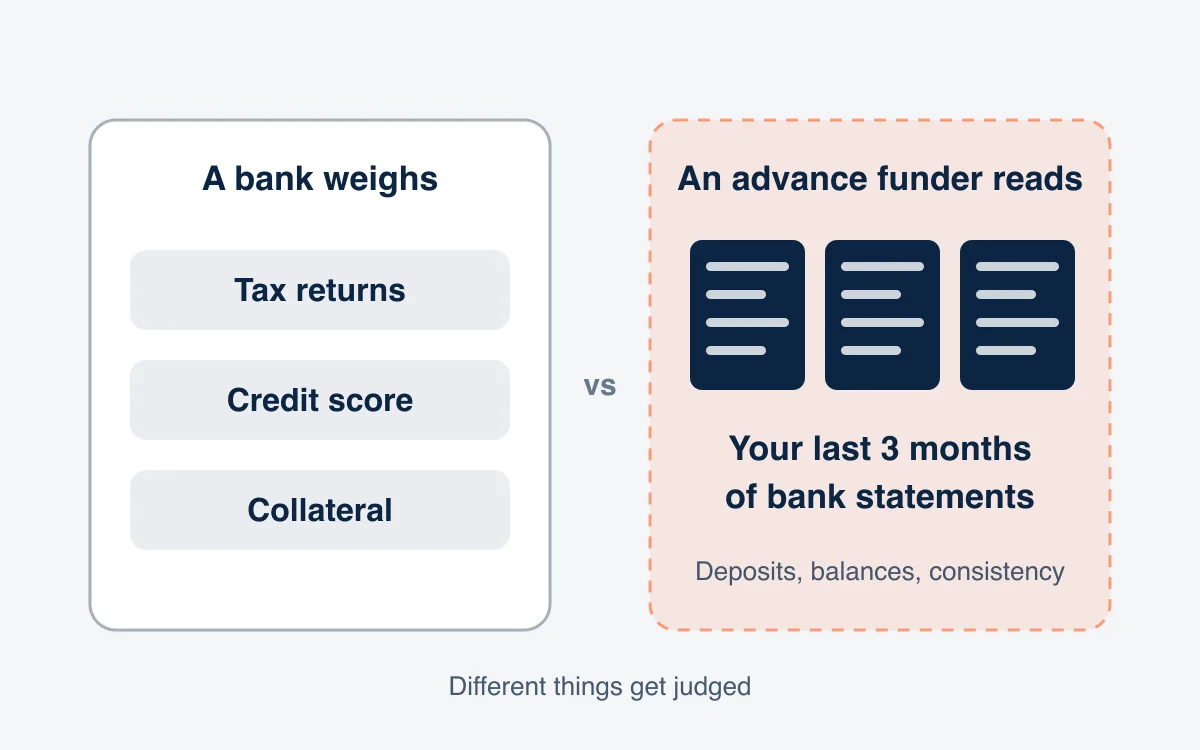
- Banks underwrite your tax return and credit first, so a business with strong deposits can still be declined.
- Funding providers for an advance read your last 3 months of business bank statements instead.
- Our minimum for a merchant cash advance is 4 months in business, $10,000 in monthly revenue and a 500+ FICO score.
- An advance is faster and easier to qualify for than a bank loan. The trade is a larger daily payment over a shorter window.
A merchant cash advance is the purchase of a portion of your future sales. It is not a loan.
Why banks say no
Banks decline small businesses for a handful of common reasons:
- Less than 2 years in business
- Owner credit below the bank's floor, often around 680 for a conventional loan
- No collateral
- A tax return showing low profit or a loss, even when the bank account is healthy
- Too much existing debt for the income
- A restricted industry
- Incomplete paperwork
See what your business may qualify for
About 30 seconds to start.
How funders read the same business
Funding providers for an advance look at your last 3 months of business bank statements:
- Total monthly deposits
- How consistent the deposits are
- Your average daily balance
- How many negative or overdraft days you have
- Whether deposits are real customer revenue or transfers between your own accounts
A decline is not a mark against you
Time in business and the owner's credit score are secondary checks. A funder typically does not require collateral, and a loss on a tax return does not end an advance review. A bank decline is not a mark against you: providers underwrite your statements, not the bank's opinion, and a decline is not a default.
How long each one takes
A bank often takes 2 to 6 weeks to decline a conventional small business loan, and an SBA lender can take longer. A funding provider for an advance often gives a decision within a business day or two once your statements are in. Timing depends on the provider, your documents and your bank.
Which products fit after a decline
Which product fits depends on why the bank said no.
- A merchant cash advance usually fits when the decline was for credit, collateral or time in business and the deposits are strong. Those are the gaps an advance is built around.
- Invoice factoring fits a business-to-business company with slow-paying customers, because the customers' credit decides, not the owner's.
- Equipment financing fits when the money is for equipment, because the equipment itself secures it.
- A line of credit, term loan or SBA loan is underwritten closer to the way a bank does it. Those usually have to wait until the decline reason is fixed.
Ask the bank why
Ask the bank for the specific reason in writing. A decline letter or adverse action notice names the factors. Ask which single factor was decisive, what would have to change, and when you can reapply. A decline for credit points one way, a decline for collateral or time in business points another, and a decline for paperwork may only mean resubmitting a complete file.
What you can fix in 30 to 60 days
- Keep the business account cleaner, with fewer overdraft and negative days and steadier ending balances
- Stop mixing personal spending into the business account
- Pay down a small revolving balance
- Let one more clean statement month print
What 60 days will not fix
Time in business, a loss on your tax return and missing collateral can't be fixed in 60 days.
When an advance is the wrong choice
- The bank declined you for weak cash flow, because a daily remittance makes thin cash flow worse
- You need long-term money for something that pays off over years
- The daily amount would take too large a share of your average daily deposits
- You already carry advances near what your revenue can support
If a cheaper product is close
If one fixable item, such as one more clean statement month or one balance paid down, unlocks a cheaper product soon, waiting is usually better.
Compare the cost honestly
A bank loan charges interest on a shrinking balance and is repaid monthly over years, so the daily cost is low and the total interest is modest. An advance is priced as a factor rate on the amount you take. At the usual 1.25 to 1.50 range, $50,000 means $62,500 to $75,000 to remit in total, collected on business days over months, not years. At 1.35, that same $50,000 is $67,500 in total, about $536 per business day over roughly 6 months. So the advance is faster and easier to get. The trade is a much larger daily payment over a much shorter window, and a higher total cost.
The real downsides
- The total cost is higher than a bank loan
- The daily remittance runs whether the week was good or bad, which puts pressure on cash flow
- The short term concentrates that pressure
- Renewals or a second advance taken to keep up can turn one advance into a cycle
- Most advances do not build business credit the way a bank loan does
- Most agreements include a personal guarantee, so read exactly what you would be responsible for if the business closes
Mistakes right after a decline
- Taking the first offer without comparing the total amount to remit
- Stacking a second advance to cover the first one's remittances
- Never checking the daily remittance against your average daily balance
- Hiding an existing advance, which the funder sees on your statements anyway
- Spending the money on old bills instead of something that produces revenue to carry the payments
Warning signs
- Guaranteed approval claims
- Anyone who will not put the total amount to remit in writing before you sign
- Pressure to sign the same day
- Anyone who calls an advance "just like a loan, only faster." It is not a loan, and the difference matters.
- Anyone who suggests overstating revenue or altering statements, which is fraud
- Documents that waive your rights or allow a judgment without a court process. Read them first, or have someone explain them.
What to have ready
- Your last 3 complete business bank statements, as full PDFs from the bank with every page
- A completed application
- A driver's license
- A voided check
- The bank's decline letter, if you have it, because it shows why the bank said no and helps point you to the right product
A landscaping company, worked through
| Business | Landscaping company, 14 months in business |
|---|---|
| Average monthly deposits | $38,000 |
| Bank result | Declined after 5 weeks: owner score 612, no collateral |
| Advance amount | $30,000 |
| Factor rate | 1.38 |
| Purchased amount (total to remit) | $41,400 |
| Term | About 8 months (168 business days) |
| Daily remittance | About $246 |
| Share of average daily deposits | About 14% |
Example only, an illustration and not a real client or a quote. Actual amounts, factor rates and terms depend on the funding provider and your statements.
Subject to approval. Amounts, timing and terms vary and are not guaranteed.